
Waves Lab
Physics · Cambridge O Level · Waves · Motion, frequency and wavelength
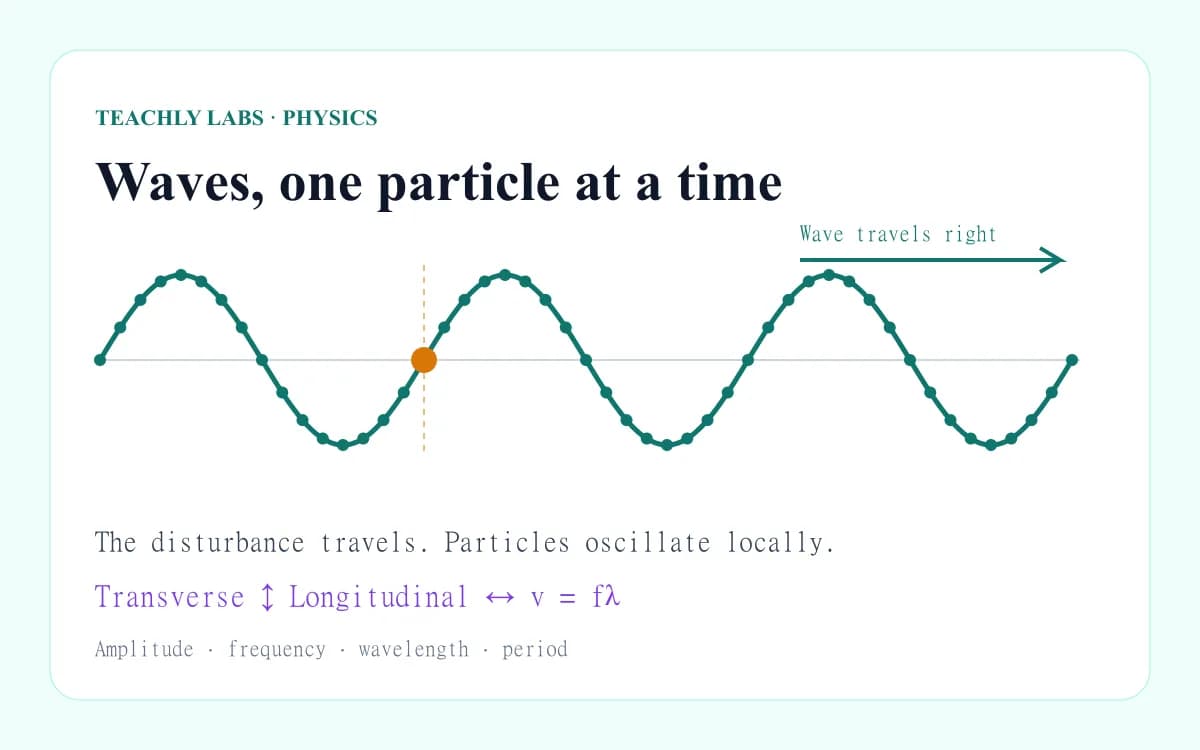
Follow a travelling disturbance and a single oscillating particle. Compare transverse and longitudinal waves and explore v = fλ.
Free to explore. The interactive lab loads only when you start. No account or saved progress.
© teachly.lk
Things to try
- Play the transverse wave. Follow the amber particle: does it travel right with the disturbance or oscillate around one position?
- Pause and Step through a period. Compare the selected particle in the medium with its displacement–time trace.
- Keep speed fixed and double frequency. Predict and measure the new wavelength and period.
- Switch to longitudinal. Find a compression and a rarefaction. Explain why maximum displacement is not the centre of a compression.
- Set amplitude to zero. Then try the longest wavelength: explain why a full wavelength no longer fits in the window.
Key ideas
- A wave transfers a disturbance through a medium while its particles oscillate locally. This ideal model has no bulk particle drift.
- Transverse oscillations are perpendicular to propagation; longitudinal oscillations are parallel. Compressions have closer particle spacing and rarefactions have wider spacing.
- Wave speed equals frequency times wavelength: v = fλ. At fixed speed, increasing frequency decreases wavelength.
- Period is the time for one oscillation: T = 1/f. Amplitude is maximum displacement from equilibrium.
- The continuous sinusoidal wave travels right. Displayed phase loops at two periods; the finite drawing window is not a reflecting boundary.
Exam tip
Distinguish a snapshot of displacement against position from a particle displacement–time graph. Measure wavelength on the position graph and period on the time graph. Use consistent SI units in v = fλ.
Related
Want help with waves · motion, frequency and wavelength?
Find a Physics tutor