
Straight-Line Graph Lab
Maths · Cambridge O Level · Chapter 6 Graphs · 6.2 Straight lines · 6.3 Parallel and perpendicular
Change m and c in y = mx + c. Read the gradient triangle and y-intercept, then compare parallel and perpendicular lines.
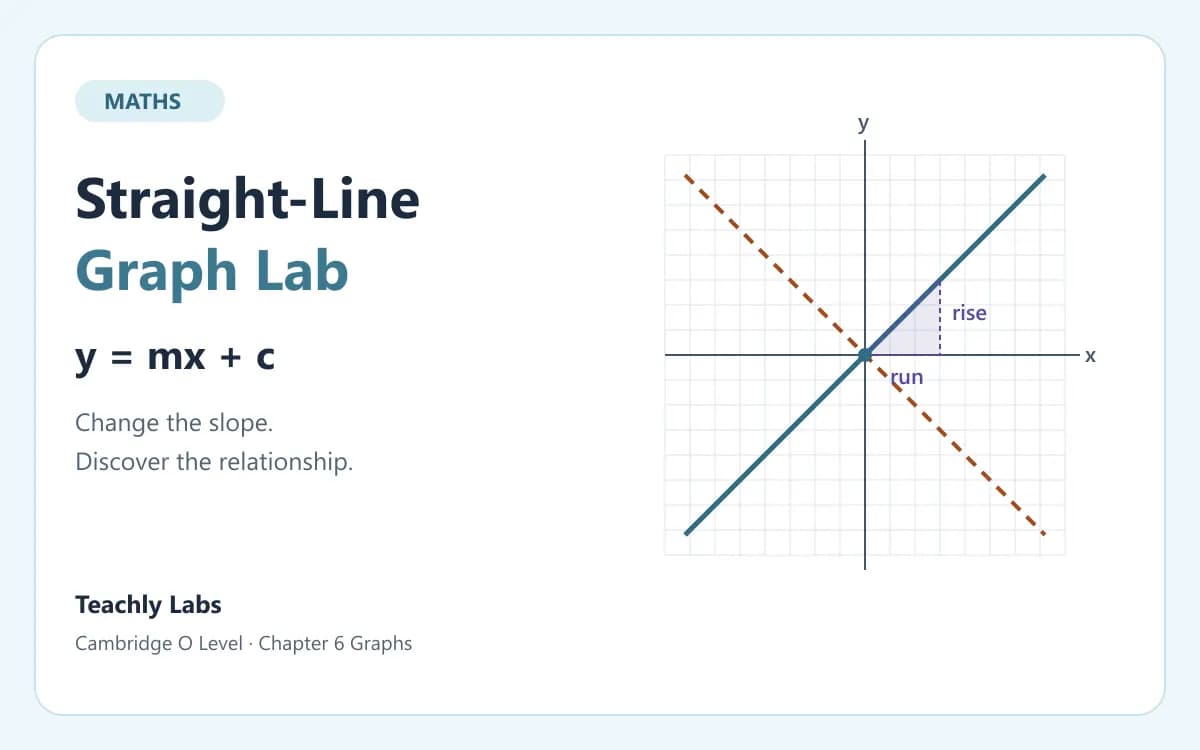
Free to explore. The interactive lab loads only when you start. No account or saved progress.
© teachly.lk
Things to try
- Keep c = 1. Move m from −2 to 0 to 2. Explain how the direction and steepness change.
- Set m = 0.5. Use the gradient triangle to check that rise ÷ run = 0.5. Then try a negative gradient.
- Keep m = 2 and change c. Which coordinate stays fixed where each line crosses the y-axis?
- Choose Parallel. Change the second intercept, then match it to c. Explain the difference between distinct parallel lines and coincident lines.
- Choose Perpendicular. Try m = 2 and m = −0.5. Check that m₁ × m₂ = −1, then set m = 0 and explain the vertical-line exception.
Key ideas
- In y = mx + c, m is the signed gradient and c is the y-intercept. The line crosses the y-axis at (0, c).
- Gradient is change in y divided by change in x. A horizontal line has zero gradient; a vertical line has undefined gradient.
- Distinct non-vertical parallel lines have the same gradient and different intercepts. Equal gradients and equal intercepts describe the same line.
- Non-vertical perpendicular lines have gradients whose product is −1. A horizontal line is perpendicular to a vertical line, so that product rule cannot be used for this special case.
- Both axes use the same scale here. The graph window is −8 to 8; a steep line continues beyond the visible window.
Exam tip
Calculate gradient using two points on the line: (y₂ − y₁) ÷ (x₂ − x₁). Keep the subtraction order the same. For a perpendicular gradient, take the negative reciprocal; do not divide by zero for a horizontal line.
Related
Want help with chapter 6 graphs · 6.2 straight lines · 6.3 parallel and perpendicular?
Find a Maths tutor