
Quadratic Graph Lab
Maths · Cambridge O Level · Graphs · Quadratic functions and simultaneous equations
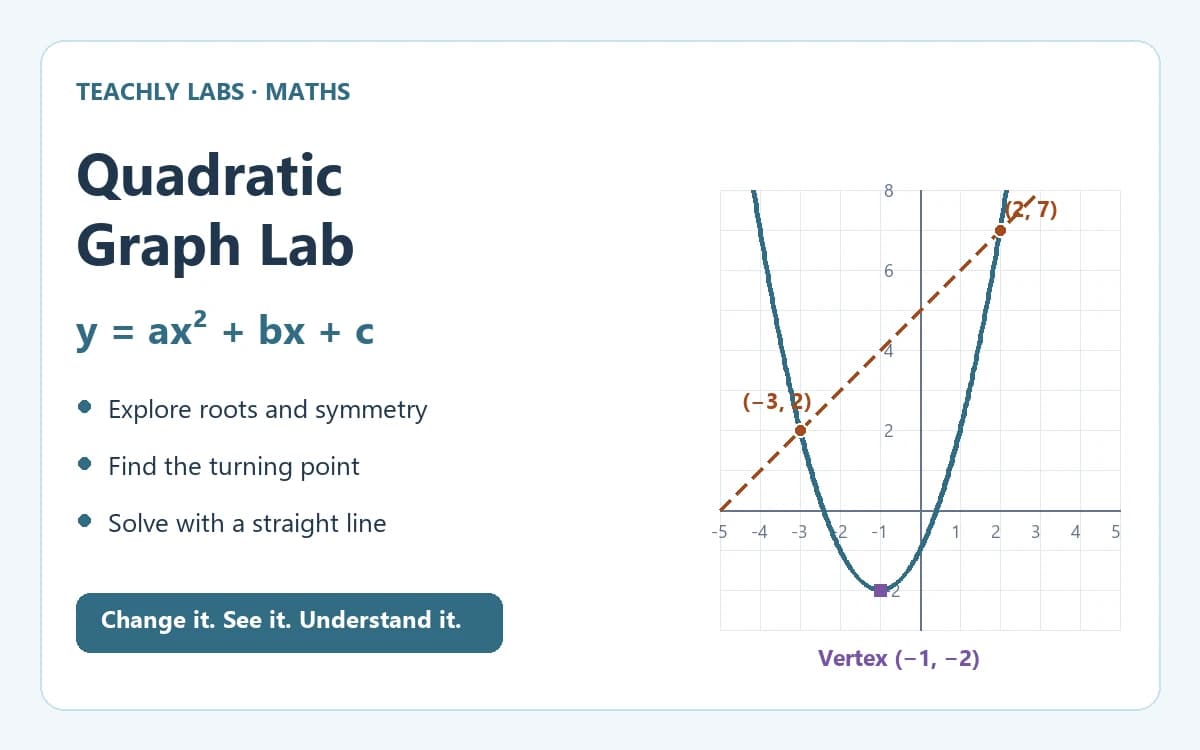
Change a, b and c to explore a parabola. Find roots, symmetry and the turning point, then compare the curve with a straight line.
Free to explore. The interactive lab loads only when you start. No account or saved progress.
© teachly.lk
Things to try
- Load the Lesson example. Confirm the minimum (−1, −2) and the crossings (−3, 2) and (2, 7). Explain why a graph intersection satisfies both equations.
- Turn off the straight line. Choose Two roots, Repeated root and No real roots. Compare the x-axis crossings and the discriminant.
- Set b = 0 and c = 0. Compare a = 0.5, 1 and 2, then a = −1. Predict the opening direction and width before moving the slider.
- Set a = 1 and b = 2, then vary c. Track the y-intercept and turning point. Does the symmetry line move?
- Set a = 0. Try b = 1, c = 5 with the example line visible. Then change c to 2. Explain coincident and distinct parallel lines without inventing a quadratic vertex.
Key ideas
- In y = ax² + bx + c, a non-zero a gives a parabola. Positive a opens upward; negative a opens downward. The y-intercept is (0, c).
- The turning point has x = −b/(2a). Substituting this x into the equation gives its y value. The vertical line through it is the axis of symmetry.
- The discriminant b² − 4ac is positive for two distinct real roots, zero for a repeated root, and negative for no real roots. This rule describes quadratics, so a must be non-zero.
- At a curve/line intersection, ax² + bx + c = mx + k. Rearrange to ax² + (b − m)x + (c − k) = 0, then substitute each solution into the line.
- When a = 0, solve the remaining linear or constant equation instead. A coincident pair has infinitely many intersections. Displayed values are rounded when needed; some features can lie outside the fixed plot.
Exam tip
Distinguish roots (crossings of the x-axis) from intersections with another graph. Read both coordinates at a crossing. Use a smooth curve and check answers by substitution; do not mistake a cropped graph window for the end of a curve.
Related
Want help with graphs · quadratic functions and simultaneous equations?
Find a Maths tutor