
Particle States & Heating
Chemistry · O Level · States of matter · Heating curves
Heat and cool water, follow its particles and discover why temperature stops rising during a change of state.
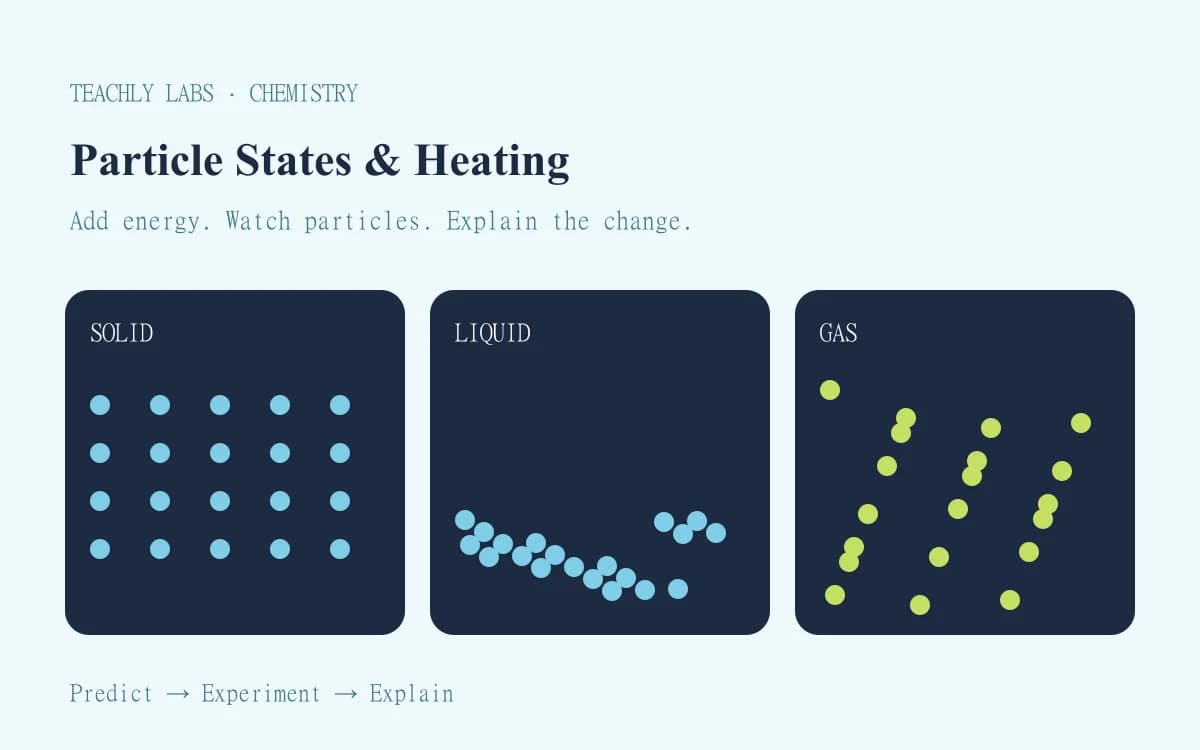
Free to explore. The interactive lab loads only when you start. No account or saved progress.
© teachly.lk
Things to try
- Predict what happens to temperature while ice melts. Add energy and test your prediction.
- Compare solid, liquid and gas particle motion. What changes and what stays the same?
- Pause halfway through boiling. Explain where the added energy goes.
- Cool steam back into water and then ice. Follow the same curve in reverse.
Key ideas
- Solid particles vibrate near fixed positions. Liquid particles move past neighbours. Gas particles are widely separated and move freely.
- At normal atmospheric pressure, pure water melts at 0°C and boils at 100°C.
- During a phase change, energy changes intermolecular arrangements rather than raising temperature. Water molecules remain water molecules.
- This ideal model neglects heat losses and uses approximate constant heat capacities. Particle spacing and motion are illustrative, not to scale.
Exam tip
A horizontal section of a heating curve does not mean heating has stopped. Identify the change of state and explain the energy transfer.
Related
Want help with states of matter · heating curves?
Find a Chemistry tutor