
Meal Journey Lab
Biology · Cambridge O Level · Human nutrition
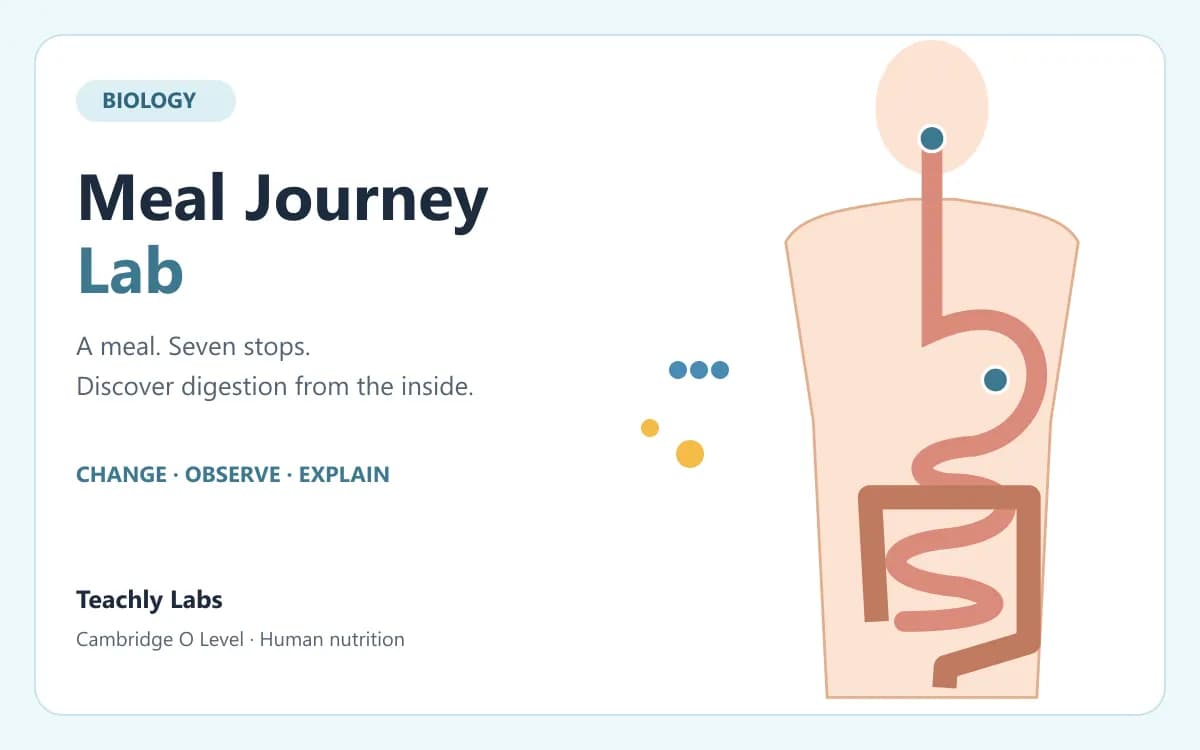
Follow a meal through the digestive system. Change enzymes, bile and absorption to discover what each organ does.
Free to explore. The interactive lab loads only when you start. No account or saved progress.
© teachly.lk
Things to try
- Turn off hydrochloric acid. Is protein still digested? Which enzyme rescues it later?
- Turn off bile. Watch the fat drops in the duodenum. What comes out at the end?
- Leave saliva on and watch starch in the stomach. Why does salivary amylase stop?
- Switch off the villi. Where does the glucose end up?
- Turn off peristalsis. Can the food reach the stomach?
Key ideas
- Physical digestion makes smaller pieces without changing food molecules. Enzymes carry out chemical digestion.
- Enzymes work best in particular pH conditions. Acid supports pepsin; neutralising stomach acid supports enzymes in the small intestine.
- Bile is not an enzyme. It emulsifies fat into droplets, increasing the surface available to lipase.
- Digestion produces small soluble molecules. Absorption moves these into the body; egestion removes undigested material.
- This is a simplified particle model. Counts represent model units and journey times are accelerated, not real digestion times.
Exam tip
Name the process, the enzyme or structure, and the product or destination. Distinguish bile emulsifying fat from lipase digesting it, and absorption from egestion.
Related
Want help with human nutrition?
Find a Biology tutor