
Circuit Lab
Physics · Cambridge O Level · Electric circuits
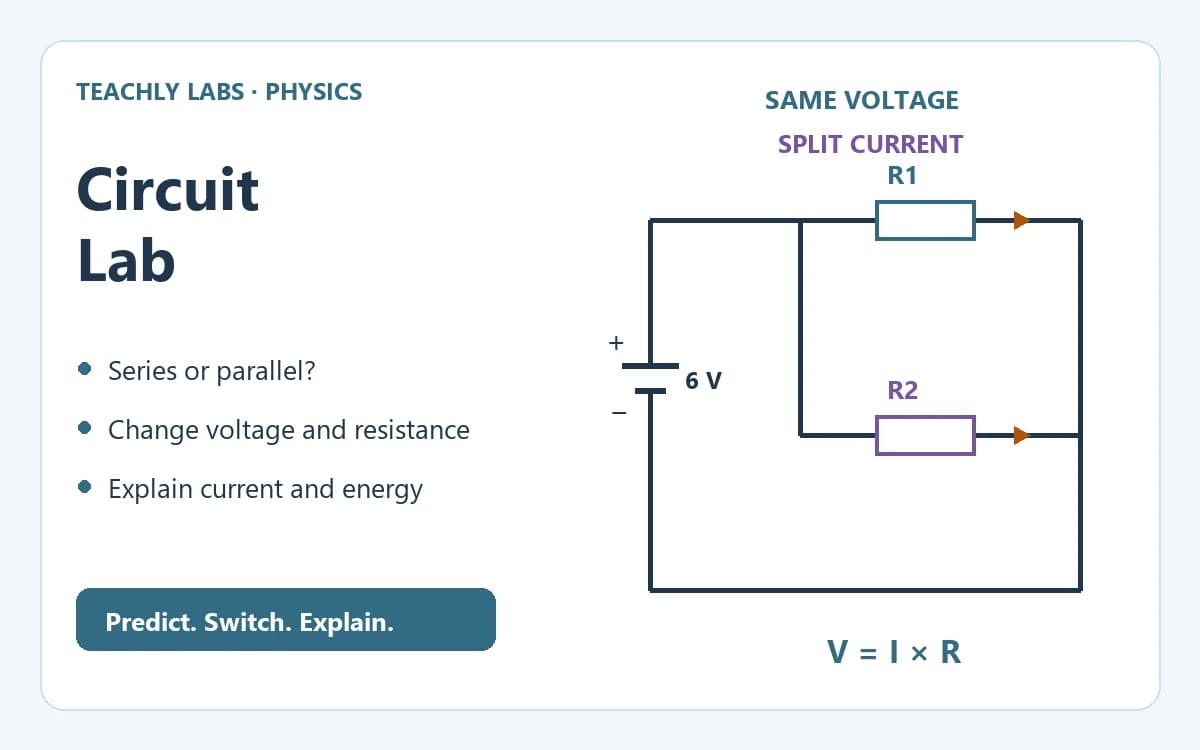
Compare series and parallel circuits. Change voltage and resistance, open switches, and explain the current.
Free to explore. The interactive lab loads only when you start. No account or saved progress.
© teachly.lk
Things to try
- Start with Equal series. Predict the current for a 6 V source and two 10 Ω resistors, then check the readouts.
- Keep the resistors unchanged and choose Parallel. Compare the load resistance, source current and voltage across each resistor.
- Load Unequal parallel. Open the R2 switch. What changes in R1, R2 and the source current? Try the same switch in Series.
- Double the supply voltage with the resistance fixed. Explain the current change using V = IR. Then set the voltage to zero.
- Compare source power with the sum of both resistor powers. Explain where the energy goes without saying current is used up.
Key ideas
- In a closed series circuit, resistors carry the same current. Their resistances add, and their potential differences add to the supply voltage.
- Parallel resistors share the same two nodes. Each connected branch has the supply voltage, and the source current is the sum of branch currents.
- An open switch interrupts its path. In parallel, another closed branch can still carry current.
- V = IR links voltage, current and resistance for an ohmic resistor. Power P = VI describes the rate of energy transfer.
Exam tip
Label current in amperes (A), potential difference in volts (V), and resistance in ohms (Ω). Identify complete paths before calculating. Never assume current is shared equally in unequal parallel branches.
Related
Want help with electric circuits?
Find a Physics tutor